
You’ve just launched your website, but are not able to get the right audience. So how do you get it in front of the right people? Without a solid SEO foundation, even the best site can get lost in the massive online world. If you want to overcome these issues and reach the right audience! Then u are at the right place to help you. We are here with the ultimate SEO checklist with 10 essential steps to start ranking on the search engine results page.
This ultimate SEO checklist will provide you with 10 Essential steps to start SEO ranking on Google to make your website discoverable on the Google search engine in the massive online world. This checklist will help bloggers, startups, small business owners, and anyone new to SEO to rank their website on search engines.
Pre-Launch Essentials: Building the base for achievement
When your website goes live, there are some Problem that occurs before or immediately after publishing it. This often includes technical performance or user experience issues. To improve SEO, here is 1 of the 10 steps to start SEO ranking. Here is a quick breakdown.
Ultimate SEO Checklist step 1: Define Your Niche & Audience (Before Anything Else!)
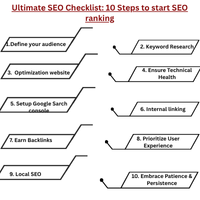
Before you even think about keywords, pause and truly understand who your website is for and what problem it solves. Are you selling artisan coffee beans, offering local dog walking services, or sharing travel tips for budget adventurers? Clearly defining your niche and target audience will guide every subsequent SEO decision you make. Who are you talking to? What are their needs?
The Foundation: Keyword Research ( one of the most essential steps in the ultimate SEO checklist)
Checklist Item 2: Conduct Foundational Keyword Research (speak your audience’s language)
Keywords are the terms our target audience searches for, while keyword research is the process by which we identify the terms our audience searches for.
There are three types of keywords:
Primary Keyword: The main Keyword where we have to rank our web page.
Secondary Keyword: Secondary keywords are the supporting keywords of the Primary keyword
LSI Keyword (Latent Semantic Indexing): LSI keywords are the synonyms of the Primary Keyword
There are multiple bases on which keyword research is done:
Based on Intent
When writing an article with a specific purpose or intent, we research and select the right keywords to ensure your content reaches the right audience and delivers maximum impact.
1. Information keyword:
These keywords are used to find information or learn something, which are Ideal for blog posts and articles.
2. Commercial keyword:
These Keywords are used to compare products or services before purchase. which are ideal for product reviews and comparison content.
3. Transectional keywords:
Keywords with high buying intent that focus on driving conversions are transactional.
4. Nevigational keywords:
Keywords that are used to find a specific website or brand. Targeting brand-aware users is known as navigational keywords.
Based on competition
1. High competition keywords:
These are Popular and frequently searched terms and are Difficult to rank for without strong SEO.
2. Low competition keywords:
These are niche-specific and less competitive terms and are easier to rank on the search engine results page with strong content and a targeted audience, and following all the other steps given in the ultimate seo check, you can create an article and make it rank on serp
Based on the targeted audience
1. Branded keywords:
It includes brand names. It has a niche but specific targeted audience and gets High intent from loyal customers.
B. Non-Branded Keywords
It excludes brand names and attracts a broader audience.
C. Geo-Targeted Keywords
6. Other Specialized Keywords
A. Seasonal Keywords
Relevant during specific times of the year. That boosts seasonal traffic
B. Evergreen Keywords
Always relevant, regardless of time, which drives consistent traffic over time
Before you write a single word or optimize a single page, you need to understand what your target audience is searching for. Keyword research is paramount. Utilize tools like Google Keyword Planner, Ahrefs, or SEMrush to identify relevant keywords that strike a good balance between search volume and low competition. Think about both broad “head terms” and more specific “long-tail keywords.”
Keyword research plays the most significant role in SEO using
Checklist step 3: Optimize Your On-Page Elements: The Basics Done Right
This is where you weave your chosen keywords naturally into your website’s fabric. Think of it as giving search engines clear signposts:
Catchy Page Titles:
Every page requires a unique, descriptive title (under 60 characters) that incorporates your primary keyword. This is the first thing people see in search results!
Enticing Meta Descriptions:
Craft a compelling summary (around 150-160 characters) for each page. This snippet doesn’t directly impact ranking but hugely influences click-through rates.
Structured Headings (H1, H2, H3):
Use these to break up your content and signal to both users and search engines what each section is about. Your H1 should contain your primary keyword.
Quality Content:
This is non-negotiable. Write genuinely helpful, engaging, and well-researched content. Google loves content that provides real value.
Image Alt Text:
Describe your images using relevant keywords. This helps visually impaired users and gives search engines more context.

Checklist step 4. Ensure Technical Health: Make Friends with Crawlers
Even the best content won’t rank if search engines can’t properly access and understand your site. This is your technical backbone:
Check Your Robots.txt File:
This file tells search engine crawlers which pages they can and cannot access. Make sure it’s not accidentally blocking important content.
Mobile-Friendly Design:
Your site must look and function perfectly on smartphones and tablets. Google uses mobile-first indexing, meaning it primarily uses the mobile version of your content for ranking.
Blazing Fast Site Speed:
Users (and Google!) hate slow websites. Optimize images, leverage caching, and choose a reliable host.
Install an SSL Certificate (HTTPS):
This encrypts data transferred between your site and users. It’s a fundamental security measure and a ranking factor.
Create an XML Sitemap:
This is essentially a map of your website that helps search engines discover all your important pages. Submit it to Google Search Console.
Checklist step 5: set up Google Search Console and Google Analytics
Google Search Console is a free tool offered by Google that assists website owners, marketers, and SEO professionals in monitoring, maintaining, and troubleshooting their site’s visibility in Google Search results. In contrast, Google Analytics is another tool provided by Google that helps you track and understand how visitors interact with your website.
Google Analytics helps to:
- Understand what’s working and what’s not
- Make fact-based decisions to enhance your website and marketing.
- Identify conversion bottlenecks/ conversion barriers
- Learn more about your target audience.
While Google Search Console helps to
- Improve your Google rankings.
- Ensure your site is being properly crawled and indexed.
- Fix SEO problems quickly.
- Make informed decisions to increase traffic.
To address this issue and enhance your SEO ranking, consider utilizing Google Search Console to verify your website and install your Google Analytics tracking code.
Checklist step 6: Internal Linking: Guide Your Users & Google
Think of internal links as pathways within your own website. Link related pages together using descriptive anchor text (the clickable words). This helps users navigate your site, keeps them engaged longer, and distributes “link juice” (ranking power) across your pages. For example, if you have a blog post about “best coffee brewing methods,” link it to your “French press” product page.
Checklist step 7: Start Earning Backlinks: Get Votes of Confidence
Backlinks (links from other reputable websites to yours) are like endorsements. They signal to search engines that your content is valuable and trustworthy. For a new website, this can feel daunting, but start small:
- Create Amazing Content: Truly remarkable content naturally attracts links.
- Guest Blogging: Offer to write a helpful article for a non-competing website in your niche.
- Directory Submissions: List your business in relevant online directories (especially if you’re local).
- Broken Link Building: Find broken links on other sites and suggest your relevant content as a replacement.
Checklist step 8: Prioritize User Experience (UX): Happy Visitors, Happy Google
Google aims to display users with the best possible results, which includes a pleasant experience after they click.
- Easy Navigation: Is your menu easy to navigate? Can users find what they’re looking for quickly?
- Readability: Use clear fonts, sufficient line spacing, and break up long paragraphs.
- Engaging Design: A visually appealing and intuitive design encourages users to stay.
- Clear Calls to Action (CTAs): What do you want users to do next? Make it obvious!
The 9th step of the ultimate seo checklist: For Local Businesses: Optimize for Local SEO
If your business serves a specific geographic area, local SEO is non-negotiable.
- Google My Business (GMB): Claim and thoroughly optimize your GMB profile with accurate information, photos, and services. Encourage reviews!
- Consistent NAP: Ensure your Name, Address, and Phone number are identical across your website and all online directories.
- Local Keywords: Incorporate city/region-specific keywords into your content (e.g., “best coffee shop in Seattle”).
Checklist step 10: Embrace Patience & Persistence: SEO is a Marathon!
This is perhaps the most crucial step for new websites. SEO doesn’t deliver instant results. It takes time for search engines to crawl, index, and evaluate your site. Stay consistent with your efforts, keep creating valuable content, monitor your progress using GSC and Analytics, and iterate based on what you learn. The digital landscape is constantly evolving, so your SEO strategy should too!
It’s tempting to expect immediate results after launching a new website and implementing your initial SEO strategy. However, the truth is, SEO is a long-term game. Search engines like Google need time to discover, crawl, index, and evaluate your website’s content and authority. Think of it as planting a seed – you water it, nourish it, but you can’t force it to grow overnight.
For new websites, gaining significant organic traffic and climbing the search engine rankings can take months, sometimes even longer. This period requires consistent effort and a resilient mindset. Don’t get discouraged if you don’t see your site on the first page of Google within weeks.
Your job now is to continually:
Create Valuable Content:
Regularly publish fresh, high-quality, and relevant content that targets your carefully chosen keywords. This shows search engines that your site is active and a valuable resource.
Monitor Performance:
Regularly check your Google Search Console and Google Analytics for insights. Are specific pages performing better? Are there any crawl errors? Which keywords are bringing you impressions, even if clicks are still low?
Refine & Adapt:
SEO is dynamic. Google’s algorithms evolve, and your competitors will be optimizing too. Use the data from your analytics to refine your on-page SEO, improve site speed, and identify new keyword opportunities.
Build Authority:
Continue to earn high-quality backlinks by creating shareable content and fostering relationships within your industry.
Remember, every bit of effort you put in now contributes to compounding returns over time. Stay persistent, focus on providing the best possible experience for your users, and gradually, your new website will establish its authority and climb those coveted search engine ranks.
By diligently following this ultimate SEO checklist, you’ll give your new website the best possible start in the world of SEO and pave the way for long-term organic growth. Good luck, and happy ranking!
Thanks for reading this article, ” The ultimate SEO checklist,” and if u find this article helpful, then visit our site for more information
